Dua is the heart of a believer’s relationship with Allah. It is the quiet conversation we have with our Lord in moments of hope, gratitude and need. Nowhere does that conversation feel more alive than on the journey to His sacred House. For anyone blessed with the chance to perform Umrah, the pilgrimage becomes one long, unbroken supplication, from the first intention at home to the final farewell of the Kaaba. Knowing which duas to recite, and understanding their meaning, turns the journey into a deeply personal act of worship rather than a series of unfamiliar motions.
This short guide walks through the supplications that accompany the pilgrim at each stage, along with a few gentle reminders on how to make your duas from the heart. Whether you are preparing for your first Umrah or simply wish to deepen your understanding, may these words help you draw closer to Allah on the most blessed of journeys.
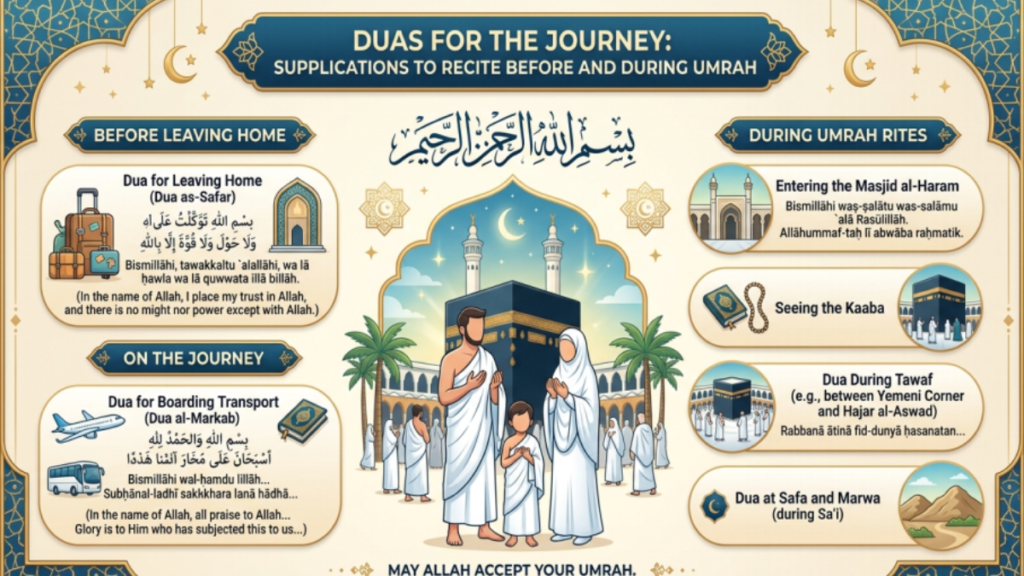
The dua of intention before you travel
Every act of worship begins with intention, and the journey to Makkah is no exception. Before you leave home, turn to Allah with a sincere heart, asking Him to accept your Umrah, to keep you safe on the road, and to make the path easy. There is no fixed wording required for this; the Prophet, peace be upon him, taught us to seek Allah’s protection and blessing when setting out on any journey.

This is a beautiful moment to gather your hopes. Many pilgrims quietly list, in their own words, the things they most wish to pray for while they are there: forgiveness, guidance, the wellbeing of their family, and the needs of those who asked them to pray on their behalf. Carrying these intentions with you means no precious moment at the Haram is spent searching for words.
The Talbiyah: the call of the pilgrim
Once you enter the state of ihram, the Talbiyah becomes your constant companion. Its words, “Labbayk Allahumma labbayk”, meaning “Here I am, O Allah, here I am”, are among the most moving in all of worship. They are the pilgrim’s answer to the call of Allah, repeated aloud again and again on the way to Makkah.
Reciting the Talbiyah with awareness of its meaning transforms it from a phrase into a heartfelt response. You are telling your Lord that you have heard His call and come running to His House. Learning it by heart before you travel, so that it flows naturally, lets you give yourself fully to its beauty rather than reading haltingly from a card.
Duas during Tawaf and Sa’i
As you circle the Kaaba in Tawaf, there is no single required supplication for each round. This is a gift, not a gap: you are free to pour out whatever is in your heart, in any language you understand. Many pilgrims recite portions of the Quran, send salutations upon the Prophet, peace be upon him, and ask Allah for the things dearest to them. Between the Yemeni corner and the Black Stone, the well-known dua asking for good in this life and the next is especially beloved.
During Sa’i, the walk between Safa and Marwah, remember that you are retracing the steps of Hajar, may Allah be pleased with her, as she searched for water for her child. Her trust in Allah in a moment of desperate need is a lesson in itself. Make your own duas here with that same trust, knowing that the One who answered her will hear you too.
Making dua from the Heart
It is easy to feel that a dua must be in perfect Arabic to be accepted, but this is not so. Allah understands every language and every unspoken thought. While learning the authentic supplications is beautiful and rewarding, never let the fear of imperfect words silence you. Speak to your Lord plainly, sincerely and often, especially in the blessed places where dua is most readily answered.
A few gentle habits help. Begin by praising Allah and sending salutations upon the Prophet, peace be upon him, before you ask. Face your requests with certainty that they will be heard. And do not rush; the quiet, unhurried moments, when you forget the crowds around you and speak only to Allah, are often the most precious of the entire journey.
A simple list of moments for Dua
If you would like to prepare, here are some of the moments during Umrah when pilgrims especially turn to Allah in supplication:
- At home, when making the intention and setting out on the journey.
- While reciting the Talbiyah on the way to Makkah.
- During each round of Tawaf around the Kaaba.
- At the Multazam, the area between the Black Stone and the door of the Kaaba.
- During Sa’i, between the hills of Safa and Marwah.
- After drinking Zamzam, which itself is a time for accepted dua.
Preparing Your heart before You Go
The most meaningful duas flow from a heart that has been prepared. In the weeks before travelling, spend time learning the supplications, reading their meanings, and reflecting on what you truly wish to ask of Allah. A pilgrim who arrives ready in this way finds the words come easily, leaving the heart free to feel rather than to fumble.
Practical preparation supports spiritual readiness too. Travelling with a trusted, well-organised group means fewer worries about logistics and more space for worship.
Families who arrange their pilgrimage through an experienced and reputable travel provider such as Qiblatain UK often say that having the practical details taken care of let them focus entirely on their duas and worship, which is, after all, the true purpose of the journey.
Frequently Asked Questions
Do I need to memorise duas in Arabic for Umrah?
It is beautiful and rewarding to learn the authentic supplications, such as the Talbiyah, in Arabic. However, Allah understands every language, so you may also make dua in your own words and tongue. Sincerity matters more than perfect pronunciation.
Is there a required dua for each round of Tawaf?
No. There is no fixed supplication for each round. You are free to recite the Quran, send salutations upon the Prophet, peace be upon him, or make your own duas in any language. This freedom lets you pour out whatever is in your heart.
When are duas most likely to be accepted during Umrah?
Pilgrims especially seek out moments such as during Tawaf, at the Multazam, during Sa’i, and after drinking Zamzam. That said, the whole journey is a blessed time for supplication, so turn to Allah often and with certainty.
How can I prepare my duas before travelling?
Learn the key supplications and their meanings in the weeks before you go, and prepare a personal list of what you wish to pray for, including requests from family and friends. Arriving prepared means no precious moment is lost searching for words.
Final thoughts
Umrah is, at its heart, a journey of dua. From the intention you make at home to the final glance at the Kaaba, you are in constant conversation with your Lord. Learn the supplications, understand their meanings, and above all speak to Allah sincerely and often. Prepare your heart as carefully as your journey, and you will return home having tasted the sweetness of dua in the most blessed places on earth. May Allah accept the prayers of every pilgrim who turns to Him.


