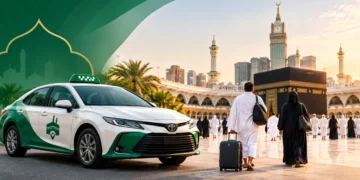
The first time a driver held out a card terminal at my Makkah hotel door, I hesitated. I had no idea whether my British card would work, or what my bank would charge. I tapped my phone, the screen showed the agreed riyal fare, and the payment went through in two seconds.
Since then, I have paid for airport transfers, the Madinah road and ziyarat tours on cards from two different countries. Most of it is simple. The money I did lose came from small choices: the wrong card, the wrong currency on a terminal, or too much cash from home.
Getting My Cards Ready Before the Flight
Most payment problems on Umrah actually start at home, so I prepare everything a few days before I fly.


- I tell each bank that I am travelling to Saudi Arabia and check that overseas payments are switched on.
- I carry two cards from different banks, in case one gets blocked.
- I add both cards to Apple Pay or Google Pay on my phone.
- I make sure I know each PIN, because some terminals ask for it on larger amounts.
- Where possible, I use a card with no foreign transaction fee, such as Wise or Revolut.
How I Paid for Each Ride Last Trip
Visa and Mastercard work on nearly every card terminal in Saudi Arabia, and so do Apple Pay and Google Pay. Here is how I paid for the main rides on my last Umrah.
| Ride | Fare (SAR) | How I paid |
| Jeddah Airport to Makkah, pre-booked Camry | 250 | Phone tap at the hotel door |
| Hotel to the Haram, Careem | 18 | Card saved in the app |
| Makkah to Madinah, pre-booked Camry | 450 | Card tap at the hotel door |
| Madinah ziyarat morning, pre-booked Camry | 150 | Phone tap at the end of the tour |
| Short street taxi near the hotel | 15 | Riyal notes, as the car had no terminal |
The only cash I needed was for that street taxi. American Express is less reliable than Visa or Mastercard, so I keep it as a backup card only.
How I Pay for a Pre-Booked Car?
A licensed pre-booked company does not take money before the car arrives. Instead, I pay the driver at the end of the ride, usually by tapping my card or phone on his terminal.
This keeps the fixed fare exactly as agreed. When I booked my Jeddah Airport to Makkah transfer, the riyal fare in the WhatsApp quote was the same amount that appeared on the terminal. My bank statement then showed the same payment converted into my home currency.
The Hidden Cost Is My Bank, Not the Exchange Rate
The Saudi riyal is fixed to the US dollar at SAR 3.75. The pound, the Canadian dollar and the Australian dollar convert at the normal bank rate.
The real cost is my own bank’s foreign transaction fee, which is usually about 3 percent on standard cards. A week of Umrah transport, including the airport transfer, the Madinah road and two ziyarat loops, costs me about SAR 2,500. A 3 percent fee on that comes to roughly USD 20. A card with no foreign fee removes this cost completely.
Card terminals sometimes ask whether to charge in riyals or in my home currency. I always choose riyals, without exception. If I choose my home currency, the terminal sets its own exchange rate, which is worse than my bank’s.
The Cash I Still Carry
Even though cards work almost everywhere, I still carry SAR 300 to 500 per week in small notes. On my last trip, every Hujjaj Umrah Taxi driver had a working terminal, so that cash went on smaller things. It covers street taxis without a terminal and drivers whose card machine loses signal, such as in a hotel basement. It also helps with small shops at fuel stations on the Makkah to Madinah road.
I withdraw riyals from a cash machine in the Jeddah arrivals hall, which gives the bank rate with a small fixed fee. Exchanging money at home usually costs several percent more, and it often comes in large notes. Drivers rarely have change for a SAR 500 note.
I never pay drivers in dollars or pounds. The few who accept foreign notes set their own exchange rate, and it is always a poor one.
Payment Requests I Always Refuse
Some payment requests are clear warning signs, and I turn them down every single time.
- Full payment in advance. If a company wants my card details before the car exists, I book elsewhere.
- PayPal to a personal account. Saudi transport companies do not use PayPal, so this request is a red flag.
- A bank transfer for a deposit. It is slower than a card, often costs more, and gives me no way to recover the money if the car never comes.
- Handing over my card, passport or phone. I tap or insert my card myself and keep it in my hand.
The best Umrah taxi asks for none of these. It confirms a fixed riyal fare in writing and takes payment only when the ride is done.
Frequently Asked Questions
Can I pay for a ziyarat tour by card?
Yes. Ziyarat tours by private taxi are priced per car, and most companies take payment by card at the end of the tour. Confirm the fixed fare and the payment method on WhatsApp before the day. Keep a little cash too, since some ziyarat sites sell dates, water or small gifts from stalls that may not accept cards.
What should I do if my card is blocked in Saudi Arabia?
Switch to your second card first, so you are not stuck. Then contact your bank through its app or the number on the back of the card. Banks often block cards after an unusual foreign payment, even after a travel notice. Most banks let you unblock the card in their app within minutes once you confirm the payment was yours.
Can two families split one taxi fare?
Yes, but agree how before the ride. Most drivers have one terminal, so one family usually pays the full fare and the other settles up afterwards. Some drivers will take two separate card payments if you ask in advance. Agree the split in the WhatsApp booking, so there is no confusion at the hotel door.
Will I get a receipt for my taxi payments?
Usually, yes. Uber and Careem email a receipt after every ride. Card terminals in pre-booked cars and official taxis can print or send a receipt if you ask the driver. The WhatsApp booking confirmation also serves as a clear record of the agreed fare. Keep these together if you need to claim travel costs later.