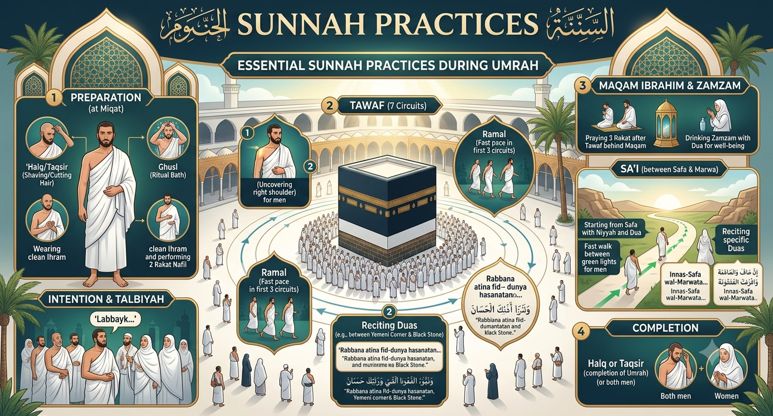
Umrah has four pillars: Ihram, Tawaf, Sa’i and shaving or trimming the hair. Perform those and your Umrah is valid. But the pilgrims who return home transformed are usually the ones who went further, following the Sunnah practices of the Prophet ﷺ at every stage. These small, deliberate acts turn a valid Umrah into a beloved one, multiplying reward without adding a single extra mile to the journey.
This guide covers the essential Sunnah practices from the moment you prepare at home until your final steps in the Haram, written in plain English for British pilgrims. Learning them takes an evening; practising them takes intention. And since a calm heart follows a well-planned trip, many pilgrims sort their travel first by booking through current Umrah Deals from UK providers, so the weeks before departure can be spent on the Sunnah rather than on spreadsheets.
Sunnah Practices Before Entering Ihram
Ghusl and Personal Grooming
Before putting on the Ihram garments, it is Sunnah to perform ghusl, a full-body wash, and to attend to personal grooming: clipping the nails, trimming the moustache and removing unwanted hair. The Prophet ﷺ did this before assuming Ihram, and it reflects the outer cleanliness that mirrors the inner purification the pilgrim is seeking. If you are travelling from the UK, many pilgrims perform ghusl at home or at the airport hotel before the flight, then enter Ihram before the plane crosses the Miqat.


Applying Perfume Before Ihram (Men)
Aisha (may Allah be pleased with her) said she would apply perfume to the Messenger of Allah ﷺ before he entered Ihram. Men may apply perfume to the body, such as the head and beard, before making the intention, but not to the Ihram garments themselves, and no perfume may be applied once Ihram begins. Women do not wear perfume in the presence of non-mahram men at any time.
The Two Rak’ahs and the Talbiyah
If it is not a discouraged time for prayer, offer two rak’ahs before assuming Ihram, then make your intention and begin the Talbiyah: “Labbayk Allahumma labbayk…” Men raise their voices with it, women recite softly, and it continues, repeated often, until Tawaf begins. The Talbiyah is the badge of the pilgrim; the Prophet ﷺ and his Companions filled the road to Makkah with it.
Sunnah Practices When Entering the Haram
Enter Masjid al-Haram with your right foot first, reciting the dua for entering any mosque: “Allahumma iftah li abwaba rahmatik”, meaning “O Allah, open for me the doors of Your mercy.” Approach with calmness and humility rather than rushing. Your first sight of the Kaaba is a treasured moment, so pause, praise Allah and make heartfelt dua before beginning Tawaf.
Sunnah Practices During Tawaf
Idtiba: Baring the Right Shoulder
For men, it is Sunnah in the Tawaf of arrival to drape the Ihram cloth under the right armpit and over the left shoulder, leaving the right shoulder bare. This is called Idtiba and applies only during this Tawaf, not during prayer and not for the rest of the trip.
Raml: Walking Briskly in the First Three Circuits
Also for men, the Sunnah of Raml means walking with short, quick steps in the first three circuits of the arrival Tawaf, then walking normally for the remaining four. It commemorates the Companions who demonstrated their strength before the Quraysh, and it remains part of the Sunnah wherever crowd conditions allow it safely.
The Black Stone and the Yemeni Corner
Begin each circuit at the Black Stone. If you can kiss it without harming anyone, do so; if not, touch it and kiss your hand; if even that is impossible, simply point towards it and say “Allahu Akbar” from a distance. Never push or fight through the crowd, as harming fellow pilgrims to reach a Sunnah defeats its purpose. Touch the Yemeni Corner with your right hand if you can reach it, and between it and the Black Stone recite: “Rabbana atina fid-dunya hasanah, wa fil-akhirati hasanah, wa qina ’adhaban-nar.”
Prayer Behind Maqam Ibrahim and Zamzam
After Tawaf, offer two rak’ahs behind Maqam Ibrahim if space allows, or anywhere in the mosque, reciting Surah Al-Kafirun in the first rak’ah and Surah Al-Ikhlas in the second. Then drink Zamzam to your fill, facing the Qiblah, and make dua, for the Prophet ﷺ said Zamzam water is for whatever it is drunk for.
A quick practical note at this point: none of these beautiful moments happen without your paperwork in order. British pilgrims should arrange their Umrah Visa from UK well before booking non-refundable travel, as processing times vary through the year and stretch during Ramadan. With the visa secured early, you can focus your preparation on learning these Sunnah practices rather than chasing documents.
Sunnah Practices During Sa’i
Approach Safa reciting “Innas-Safa wal-Marwata min sha’a’irillah”, climb until you can see the Kaaba, face it, raise your hands and glorify Allah three times with personal duas in between. Repeat the same at Marwah on each length. Between the two green lights, men jog lightly, following the footsteps of Hajar’s urgent search for water, while women walk at a normal pace. The rest of Sa’i is open time for dhikr and dua in any language, including English.
Halq or Taqsir: Completing Your Umrah
The final act is cutting the hair. For men, shaving the head completely (halq) carries greater reward than trimming (taqsir); the Prophet ﷺ prayed for mercy upon those who shave three times, and upon those who trim once. Women cut only a fingertip’s length from the end of their hair. With this, the restrictions of Ihram are lifted and your Umrah is complete.
Frequently Asked Questions
What is the difference between the pillars and Sunnah acts of Umrah?
The pillars, Ihram, Tawaf, Sa’i and cutting the hair, are essential for a valid Umrah. Sunnah acts, such as Raml, Idtiba and kissing the Black Stone, add reward and follow the Prophet’s ﷺ example but do not invalidate Umrah if missed.
Is kissing the Black Stone compulsory?
No. It is a Sunnah, not an obligation. If the crowd makes it unsafe, pointing towards it and saying “Allahu Akbar” earns the Sunnah without harming anyone.
Do women perform Raml and Idtiba?
No. Both practices are for men only. Women walk normally throughout Tawaf and Sa’i, including between the green lights.
Should men shave or trim their hair after Umrah?
Shaving (halq) is more rewarding, as the Prophet ﷺ supplicated for those who shave three times before those who trim. Trimming is fully valid, and many pilgrims trim on a first Umrah of a trip so they can shave after a later one.
Final Thoughts
The Sunnah practices of Umrah are not extras bolted onto the journey; they are the journey as the Prophet ﷺ himself performed it. Learn them before you fly, practise them with gentleness towards the pilgrims around you, and your Umrah will carry the imprint of the best of guidance from the first ghusl at home in the UK to the final cut of hair in Makkah.
May Allah grant you an Umrah performed upon the Sunnah, accepted in full, and rewarded beyond measure. Ameen.