


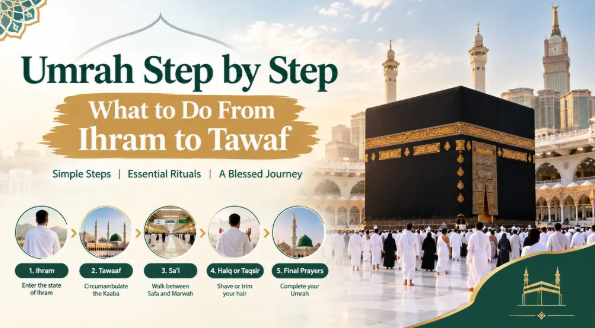
Umrah is a sacred journey that allows Muslims to worship Allah, seek forgiveness, and visit the holy places of Makkah. Although Umrah is shorter than Hajj, knowing each step in the correct order can make the experience easier and more meaningful. From preparing for Ihram to completing Tawaf, every stage has its own rules and acts of worship.
For pilgrims travelling from Britain, understanding each stage of Umrah can make the journey easier to plan and manage. Along with learning the steps from entering Ihram to performing Tawaf, it is also important to arrange your flights, accommodation, transportation, and other travel needs in advance. Comparing cheap Umrah packages from the UK can help pilgrims see what is included and choose an arrangement that suits their travel plans. Before booking, always check the package details, inclusions, and terms carefully.
What Is Umrah?
Umrah is a pilgrimage to the Sacred House of Allah in Makkah that can be performed at any time of the year, unlike Hajj, which has specific dates in the Islamic calendar. The main rituals of Umrah include entering Ihram, making the intention, performing Tawaf around the Kaaba, performing Sa’i between Safa and Marwah, and completing the Umrah by cutting or shaving the hair.
Understanding the sequence of these rituals is important because it helps pilgrims perform Umrah calmly and avoid unnecessary confusion.
1: Prepare Before Entering Ihram
Before entering the state of Ihram, pilgrims should prepare themselves physically and spiritually. It is recommended to take a bath, trim the nails, remove unwanted body hair when needed, and make other personal preparations before Ihram.
Men wear two pieces of unstitched Ihram clothing, while women wear modest Islamic clothing that fulfills the requirements of their faith. Women do not have a specific color or particular garment required for Ihram.
Pilgrims should also make sure they have everything needed for the journey, including identification documents, necessary medicines, comfortable footwear, and other travel essentials.
2: Enter the State of Ihram
Ihram is not simply the clothing worn by a pilgrim. It is a sacred state in which certain actions become prohibited and specific rules must be observed.
A pilgrim entering Makkah to perform Umrah must enter Ihram before crossing the designated Miqat appropriate to their route.
Before or at the Miqat, the pilgrim makes the intention for Umrah. The intention can be made in the heart, and the pilgrim may say:
لَبَّيْكَ عُمْرَةً
“Here I am, O Allah, for Umrah.”
After entering Ihram, pilgrims should avoid actions prohibited during Ihram and focus their attention on worship.
3: Recite the Talbiyah
After making the intention, pilgrims recite the Talbiyah:
لَبَّيْكَ اللَّهُمَّ لَبَّيْكَ، لَبَّيْكَ لَا شَرِيكَ لَكَ لَبَّيْكَ، إِنَّ الْحَمْدَ وَالنِّعْمَةَ لَكَ وَالْمُلْكَ، لَا شَرِيكَ لَكَ
“Here I am, O Allah, here I am. Here I am, You have no partner, here I am. Surely all praise, blessings, and dominion belong to You. You have no partner.”
Men generally recite the Talbiyah aloud, while women recite it quietly enough to hear themselves.
The Talbiyah can be repeated frequently while traveling toward Makkah and until the pilgrim begins Tawaf.
4: Enter Masjid al-Haram
When pilgrims reach Makkah, they should enter Masjid al-Haram with humility and respect. They should focus on remembering Allah and avoid unnecessary distractions.
Upon seeing the Kaaba, many pilgrims experience a deeply emotional moment. There is no authentic specific dua that must be recited upon seeing the Kaaba for the first time, so a pilgrim may make sincere personal dua.
After reaching the Kaaba, the pilgrim prepares to begin Tawaf.
5: Begin Tawaf Around the Kaaba
Tawaf consists of walking around the Kaaba seven times. The Kaaba remains on the pilgrim’s left side throughout Tawaf.
The starting point is the area aligned with the Black Stone (الحَجَرُ الأَسْوَدُ). If possible, a pilgrim may touch or kiss the Black Stone without harming or pushing other people. If reaching it is not possible, the pilgrim can gesture toward it while saying:
اللَّهُ أَكْبَرُ
“Allah is the Greatest.”
Each complete circuit around the Kaaba counts as one round, and seven complete rounds make one Tawaf.
6: What to Recite During Tawaf
There is no single dua that must be recited during every round of Tawaf. Pilgrims can make personal dua, remember Allah, recite Quran, and ask Allah for forgiveness and guidance.
Between the Yamani Corner (الرُّكْنُ الْيَمَانِي) and the Black Stone, it is reported that the following dua is recited:
رَبَّنَا آتِنَا فِي الدُّنْيَا حَسَنَةً وَفِي الْآخِرَةِ حَسَنَةً وَقِنَا عَذَابَ النَّارِ
“Our Lord, give us good in this world and good in the Hereafter and protect us from the punishment of the Fire.”
Pilgrims should remember that Tawaf is an act of worship, so patience and consideration for other pilgrims are extremely important.
7: Complete the Seven Rounds
The pilgrim continues until seven complete circuits have been performed. It is important to keep track of the rounds carefully.
If there is uncertainty about the number of rounds completed, a pilgrim should follow the appropriate guidance from a knowledgeable scholar according to their circumstances.
After completing Tawaf, the pilgrim moves away from the immediate Tawaf area when possible so that other pilgrims can continue their worship.
8: Pray Two Rak’ahs After Tawaf
After completing Tawaf, pilgrims traditionally pray two Rak’ahs. If it is possible without causing difficulty or blocking other worshippers, they may pray near Maqam Ibrahim. If the area is crowded, the two Rak’ahs can be performed elsewhere within the mosque.
The purpose is to continue worship after completing the seven circuits and to follow the established practice associated with Tawaf.
9: Drink Zamzam Water
After Tawaf, pilgrims may drink Zamzam water and make dua to Allah.
Zamzam has a special place in Islamic tradition, and pilgrims commonly take the opportunity to drink it while asking Allah for beneficial things in this life and the Hereafter.
10: Proceed to Sa’i Between Safa and Marwah
After Tawaf, the next major ritual of Umrah is Sa’i, walking between Safa and Marwah.
Allah says:
إِنَّ الصَّفَا وَالْمَرْوَةَ مِن شَعَائِرِ اللَّهِ
“Indeed, Safa and Marwah are among the symbols of Allah.”
(Quran 2:158)
Sa’i consists of seven journeys between Safa and Marwah. The journey from Safa to Marwah counts as one, and the journey back from Marwah to Safa counts as another.
11: Complete Sa’i
Pilgrims continue between Safa and Marwah until seven journeys have been completed. Men may walk more quickly between the designated green markers, while women normally continue walking at their regular pace.
During Sa’i, pilgrims may make personal dua, remember Allah, and recite Quran. There is no requirement to use one specific dua throughout Sa’i.
12: Cut or Shave the Hair
After completing Sa’i, the final step of Umrah is Halq or Taqsir.
Men may either shave the head completely (Halq) or shorten the hair (Taqsir). Shaving the head is a distinct act mentioned in the teachings of the Prophet ﷺ.
Women do not shave their heads. Instead, they trim a small portion of their hair.
Once this step is completed, the restrictions of Ihram end and the Umrah is complete.
Where Can Pilgrims Get Umrah Guidance?
First-time pilgrims often have questions about Ihram, Tawaf, Sa’i, duas, accommodation, transportation, and other aspects of the journey. Reliable Islamic and travel resources can help pilgrims prepare before leaving for Makkah.
Hajj Umrah Hub can also be used as a relevant resource for pilgrims looking for information related to Hajj and Umrah. Before traveling, pilgrims should verify religious guidance with qualified scholars when they have questions about specific circumstances.
Common Mistakes to Avoid During Umrah
First-time pilgrims can sometimes become overwhelmed by crowds or uncertainty about the rituals. Some common mistakes include:
- Pushing or hurting other pilgrims while trying to reach the Black Stone
- Believing that every Tawaf round has a fixed compulsory dua
- Losing count of the Tawaf rounds
- Forgetting the correct Miqat for the journey
- Focusing too much on taking photographs during worship
- Neglecting patience and good manners in crowded areas
- Following unverified information about Umrah rituals
Learning the basic steps before traveling can help pilgrims concentrate more fully on worship.
Final Thoughts
Performing Umrah step by step becomes much easier when pilgrims understand the order of the rituals before arriving in Makkah. The journey begins with preparation and Ihram, followed by the intention and Talbiyah. After reaching Masjid al-Haram, the pilgrim performs seven rounds of Tawaf, prays two Rak’ahs, drinks Zamzam, completes Sa’i between Safa and Marwah, and finally cuts or shaves the hair.
The physical steps are important, but Umrah is also an opportunity for sincere repentance, dua, remembrance of Allah, and spiritual reflection. With proper preparation, patience, and reliable guidance, pilgrims can approach this sacred journey with greater confidence and focus.