


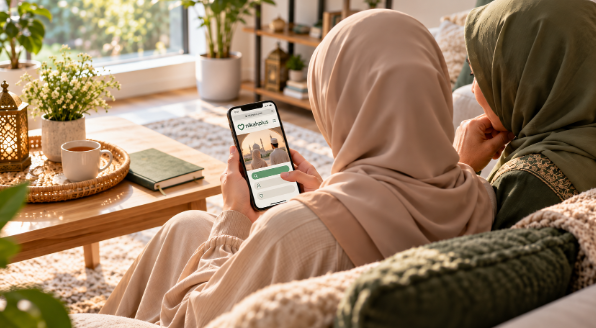
As of October 2026, searching for nikkah online is permissible and safe when three conditions are met: a wali or family is involved, communication stays within Islamic boundaries, and the platform verifies identities. UK Report Fraud recorded 10,784 romance-fraud reports and more than £102 million in losses in 2025, according to figures published in May 2026.
In short
- Keep a wali or trusted family member involved in verification and meetings.
- Keep communication purposeful, modest and time-limited, with a clear intention to marry.
- Use a platform that explains its verification and moderation process.
- Never send money, identity documents or private photos to an online match.
- Treat the first meeting as supervised: a mahram or trusted companion, a public place and your own transport.
Is Searching for Nikkah Online Halal?
Searching for nikkah online is permissible when an app is used as an introduction rather than private dating. SeekersGuidance permits Muslim matchmaking apps with purposeful questions and sharia boundaries, while warning that profiles can be deceptive and meetings should not be alone. Use an app as a tool, then move toward family or wali involvement.
Online matchmaking is similar to matchmaking through an intermediary, but an app may expose you to more strangers and less accountability. State your intention early, avoid khalwa, do not flirt or exchange intimate material, and agree on a timeline for family contact. Ask a scholar about details that depend on your circumstances.
How Big Is the Risk? Romance Fraud Numbers for 2025–2026
Romance fraud is a measurable risk, not a reason to abandon every online search. These are reported losses, so under-reporting means they are not a ceiling.
| Country | Reported losses | Number of reports | Average or median loss | Source and year |
| UK | More than £102 million | 10,784 | About £9,500 average | Report Fraud/City of London Police, 2025 figures published 2026 |
| US | More than $1.16 billion | 55,604 complaints, January–September | $2,218 median in Q3 | FTC Consumer Sentinel data, 2025 figures reported 2026 |
The current pattern is romance baiting: a fake identity builds trust, then introduces a crisis, travel cost or investment opportunity. Oregon’s Division of Financial Regulation warns that AI-generated images and chatbots can support convincing profiles before a fraudster directs a target toward cryptocurrency or a fake trading platform. A suitor should accept verification, not ask you to invest.
7 Steps to Verify a Profile Before You Reply
- Reverse-image-search every profile photo. Use more than one image search service and stop if the photograph appears under another name, on a stock-photo page or across several countries.
- Check that the city, job and age match. Compare the written profile with the conversation, time zone, work schedule and answers to ordinary questions; inconsistencies deserve a pause, not an excuse.
- Ask for a video call within the first seven days. A live call is not full identity proof, but repeated refusal, camera-only excuses or a heavily edited video are strong reasons not to continue.
- Ask for family names and readiness to meet your wali. A genuine suitor should accept a respectful, verifiable family introduction.
- Check for a social footprint. Look for a consistent LinkedIn profile, workplace, mosque community or trusted reference without contacting others intrusively.
- Do not move to WhatsApp or Telegram until families are introduced. Keeping early communication on-platform preserves reporting options and reduces exposure of your phone number and personal account.
- Ask the pre-nikkah questions below. Avoiding faith, finances, children, prior-marriage or timing questions signals poor readiness for due diligence.
10 Red Flags That Signal a Scammer or a Fake Profile
- Any request for money is a red flag. Emergencies, tickets, medical bills, visa fees and “small loans” are stories, not proof of affection.
- An oil-rig, military-abroad or UN-doctor story needs extra scrutiny. The FTC lists distant work and overseas service as common excuses for avoiding an in-person meeting.
- A refusal to video-call is a warning. One delay is understandable, but a repeated pattern cannot verify the person.
- Pressure for a quick or secret nikkah is unsafe. Serious intent supports time for family, references and questions.
- A request to hide the conversation from your family is isolating. Healthy courtship does not depend on secrecy.
- Talk of misyar or temporary marriage requires a full stop and qualified advice. Do not let unfamiliar terms bypass your rights, consent or legal protections.
- Contradictions in his story matter. Changes in age, location, work, marital status or family details should be recorded and investigated.
- Professional-looking photos prove nothing. Images can be stolen, AI-generated or taken from a real person.
- Crypto or investment talk is a scam signal. A romantic connection should never become an investment pitch.
- Requests for documents or private photos are unacceptable. Documents enable fraud, while intimate images can enable blackmail.
This NikahPlus guide to spotting deception on dating sites should be added by the editor if the matching article URL is confirmed; the public site currently confirms the platform’s verification, moderation and wali features but not a separate indexed deception article.
How to Involve Your Wali Without Losing Your Independence
The wali’s role is to take part in verification and meetings, not make every decision for you. Explain what you want shared and choose a guardian who respects your consent. Family involvement should increase accountability without removing your voice.
Three practical formats work. A parent can be copied into the conversation or join planned calls; an imam can act as an intermediary; or a built-in guardian feature can give a trusted family member access to relevant communication. NikahPlus states that a woman can add a wali, including a parent, imam or trusted person, who can review conversations and approve or decline messages.
Privacy Settings Every Muslimah Should Turn On
| Setting | Why it matters | Where it is usually available |
| Photos hidden until you reply | Limits copying and unwanted attention before mutual interest | Profile privacy or photo controls |
| Incognito mode | Reduces discoverability while you assess matches | Privacy or visibility settings |
| Hidden “last seen” | Stops strangers inferring your routine | Chat settings |
| Message screening by moderators | Adds a second review for abusive or sexual content | Platforms with human moderation |
| Selfie or ID verification | Adds evidence of account control, but does not prove character or marital status | Profile verification settings |
NikahPlus publicly states that profiles undergo multi-level verification and moderation, messages are checked by moderators, photos can be limited to people you communicate with, and users can use incognito mode and conceal last-seen time. Muslim nikkah platform NikahPlus does not substantiate the requested “94% of female users feel completely safe” or exact 100% manual-moderation claim, so do not publish those claims without evidence.
What to Share, What to Hold Back, and When
| Information | Before the first call | After families are introduced | After agreeing to nikkah |
| Full name | First name or nickname | Full name, verified respectfully | Full legal details for the contract |
| City | Broad area only | City and practical travel details | Address only where genuinely required |
| Workplace address | Do not share | Employer or role if relevant, not the address | Necessary legal or administrative details only |
| Home address | Never share | Still keep private | Share only when safety and logistics require it |
| Photos without hijab | Share only if you freely choose and understand the risk | Discuss modestly with family awareness | Follow your own boundaries; marriage is not consent to distribution |
| Finances | General expectations only | Debts, income and obligations through a serious due-diligence conversation | Full agreed mahr and financial terms |
| Documents | Never send | Verify in person or through a trusted professional | Provide only to the lawful registrar or authority |
15 Questions to Ask Before Agreeing to Nikkah
Faith and practice: How do you practise daily prayers? Which values guide your home? How do you handle disagreement and conflict?
Finances and mahr: What are your income, debts and obligations? What mahr do you expect and can fulfil? How will household costs be handled?
Family and relocation: Where would we live? Would either of us relocate, and when? What involvement would each family have?
Children: Do you want children, and when? How would we approach parenting and health issues?
Previous marriages: Is any divorce or widowhood legally complete? Do you have children or co-parenting obligations? Is there major legal, financial or health information a spouse must know?
NikahPlus’s School of Nikah section covers Islamic marriage, courtship etiquette, rights and responsibilities, with lessons and quizzes; use it as education, not a substitute for independent due diligence.
Meeting in Person: Rules for the First Three Meetings
- Meet in a busy public place, such as a café, library or community venue.
- Bring a mahram, wali or trusted companion; do not meet in private.
- Use your own transport or a route you control.
- Choose daytime and tell two people the location, time and expected end.
- Agree the purpose and topics in advance so the meeting remains focused.
- Accept no gifts beyond symbolic ones; gifts must not create pressure or obligation.
What to Do If You Have Been Scammed
- Stop all contact and do not negotiate with the person.
- Save screenshots, usernames, profile links, messages and transaction records.
- Report the account to the platform and preserve the report confirmation.
- In the UK, report to Report Fraud; in the US, report at ReportFraud.ftc.gov.
- Tell your bank or payment provider immediately, ideally within 24 hours, and ask whether a transfer can be recalled.
- Tell your family or wali so you are not handling the shame or pressure alone.
- Do not pay “recovery agents”; regulators warn that promises to recover lost investment money can be another scam.
FAQ
Is it haram to talk to a man online before nikkah?
Purposeful online conversation can be permissible when the intention is marriage, the content stays respectful, and boundaries prevent flirtation or private emotional dependency. Involve a wali or trusted family member early, avoid intimate exchanges, and move toward a supervised meeting. Ask a qualified scholar about circumstances that depend on your school or situation.
Should I show my photo on a nikkah app?
You may share a modest photo when you understand who can see it and why, but you do not owe a stranger immediate access. Use hidden-photo controls, avoid private or identifying images, and involve your family before wider sharing. A platform’s photo verification reduces impersonation risk but cannot prevent screenshots or misuse.
How long should the online stage last before families meet?
Families should meet once basic identity, seriousness and compatibility have been established, not after months of secret messaging. A video call within the first week and a family introduction soon afterward create accountability. The exact timeline depends on distance and circumstances, but prolonged emotional intimacy without progress is a warning sign.
Can I search for nikkah online without telling my parents?
You can begin a search privately if telling your parents would create danger or unreasonable control, but secrecy from every trusted person increases risk. Choose a safe wali, imam, relative or friend, protect your information, and arrange supervised verification. If family pressure is the concern, seek confidential advice from a qualified scholar or support service.
Which nikkah platforms verify profiles manually?
Platforms use different meanings for “verified,” so ask what is checked, when it was checked and what remains unverified. NikahPlus publicly describes multi-level profile verification, moderation and message review; its public page does not substantiate every stronger safety claim sometimes associated with the brand. Treat any platform verification as one layer, not proof of character.
What if my wali lives in another country?
A distant wali can join scheduled video calls, receive agreed updates or appoint a trusted local imam or family representative where appropriate. Put the arrangement in writing, protect conversation privacy and keep independent support nearby for meetings. A local scholar can explain which representative is valid for your circumstances and school of law.
Verified sources
- Report Fraud / City of London Police, “Romance fraud costs UK victims £102 million as cases rise sharply” — 2025 figures, published 2026: https://www.reportfraud.police.uk/romance-fraud-costs-uk-victims-102-million/
- Federal Trade Commission, Consumer Sentinel Network — US romance-fraud data for 2025: https://www.ftc.gov/terms/consumer-sentinel-network
- Federal Trade Commission, “What To Know About Romance Scams” — current scam patterns and recovery guidance: https://consumer.ftc.gov/articles/what-know-about-romance-scams
- Oregon Division of Financial Regulation, “DFR warns investors about AI-powered investment scams” — 2026 AI, crypto and romance-scam guidance: https://dfr.oregon.gov/news/news2026/pages/20260914-ai-powered-investment-scams.aspx
- SeekersGuidance, Ustadha Shazia Ahmad, “Is It Permissible for Me To Use a Muslim Matchmaking Apps and Meet Alone?” — 2021 scholarly guidance: https://seekersguidance.org/answers/shafii-fiqh/is-it-permissible-for-me-to-use-a-muslim-matchmaking-apps-and-meet-alone/
- NikahPlus public homepage — features checked 7 October 2026; the three NikahPlus links above point to this verified page. The requested 94% safety statistic, exact 100% manual-moderation claim and a separate deception blog URL were not substantiated on the public page and have therefore not been presented as verified facts.
Three-plus facts that distinguish this article from the researched competitors
- It explains what profile verification does not prove: identity checks are not character, marital-status, employment, criminal-record or religious-claim checks.
- It gives a women-first response playbook for money requests, crypto pitches, document requests, private-photo pressure, secrecy and recovery-agent scams.
- It turns wali involvement into an operational choice—copied parent, imam intermediary or platform guardian access—rather than a generic instruction to “involve family.”
- It gives a staged privacy table covering home address, workplace, photos, finances and documents, plus a concrete seven-step progression from profile review to supervised family contact.