

For many Muslim families in the UK, the USA, Canada, Saudi Arabia, the UAE, Denmark, Finland and Nigeria, the question is not whether children should learn the Quran. It is how to make it happen between school, work, travel and distance. The nearest mosque class may be an hour away, the timetable may clash with homework, or the teacher may not be someone your child feels at ease with.
Online Quran learning has become a practical answer. Done well, it offers live teaching at home, a schedule built around your own time zone and a clear way for parents to see progress. Done badly, it turns into a video that a child ignores. This guide explains what to look for, how interactive and game-style lessons help young learners, and how to plan lessons around your country’s school day.
It also shows how one academy, NoorPath Academy, approaches online Quran learning, so you can compare it with any other option you are considering.


Online Quran learning for Muslim families in the UK, USA, Canada, the Gulf, Denmark, Finland and Nigeria.
Why Quran Learning Looks Different When You Live Abroad
Learning the Quran has always depended on a teacher who listens and corrects. That tradition does not change, but the practical conditions do. Parents across these eight countries often describe the same pressures:
- Distance. In smaller towns, and where Muslim communities are more spread out, a qualified teacher may not be nearby. This can be true in parts of Denmark and Finland, and in the suburbs of large cities elsewhere.
- A full school day. After-school clubs, homework and sport leave a narrow window for lessons, especially for children in the UK, USA and Canada.
- Long journeys. In busy cities, including large Nigerian cities, getting to a lesson can take longer than the lesson itself.
- Short winter days. In Northern Europe and Canada, dark afternoons make evening journeys less appealing for young children.
- Busy expatriate routines. In Saudi Arabia and the UAE, many families balance international schools, work and activities. Children may hear Arabic around them and still need structured Quran reading.
- Parents who are learning too. Some parents cannot yet recite fluently themselves and want a teacher to lead.
Online lessons remove the travel, but they do not remove the need for good teaching. That is why the quality checks below matter more than the technology.
What Good Online Quran Learning Looks Like
Live one-to-one lessons, not recordings
Recorded videos are useful for revision, but pronunciation (Tajweed) is learnt by reciting aloud to a teacher who hears small mistakes and corrects them. In a live one-to-one lesson, the tutor can adjust to your child’s pace instead of teaching a whole class at an average speed.
A teacher whose credentials you can ask about
Ask directly whether the tutor holds an Ijazah or a Quran teaching certificate, and whether you can see it. A reliable academy will be comfortable answering.
A trial before you pay
A free or low-cost trial lets your child meet the tutor, hear their style and decide whether the lesson feels comfortable. It also lets you test the sound quality, the platform and the timing before you commit.
A teacher who fits your child
Age, level, time zone and gender preference all matter. Many parents of daughters and young children prefer a female tutor, and children often settle faster when the pace and tone of the lesson feel natural to them.
Progress you can actually see
Look for tutor notes, short quizzes or a parent view that shows what was practised. When parents can see progress, practice at home becomes easier to support.

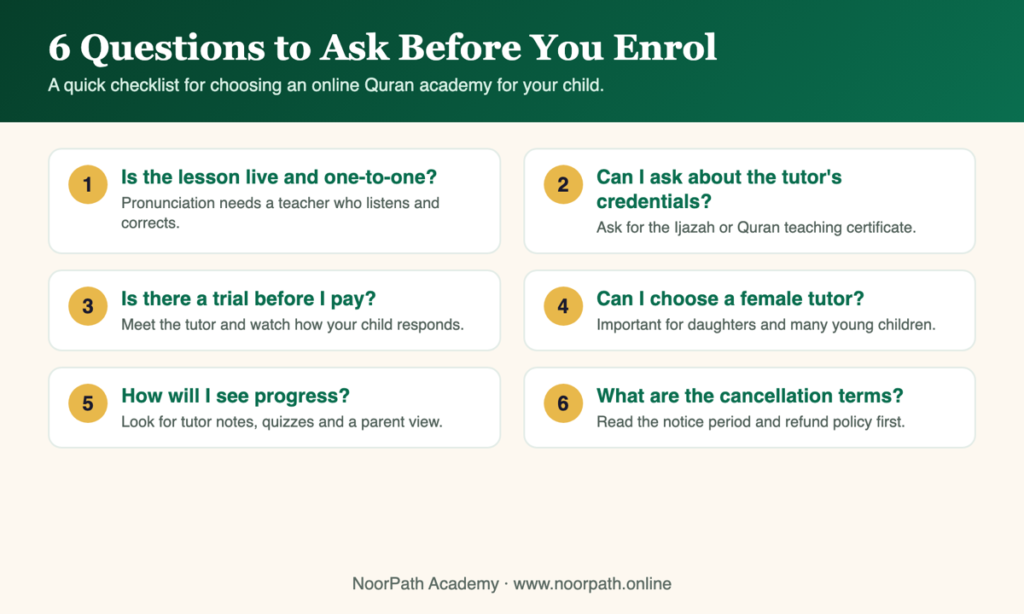
Six questions worth asking any online Quran academy before you enrol.
Interactive, Game-Style Learning: Why It Helps Children
Young children learn best in short bursts with clear feedback. A long, silent lesson can lose a four- or five-year-old within minutes, while a short activity with a clear goal keeps attention. This is where interactive and game-style learning helps.
There is also a well-known learning principle behind it. Research on retrieval practice, such as the study by Roediger and Karpicke (2006), found that being tested on material helps people remember it for longer than simply re-reading it. A letter-matching round or a short quiz is a small test, and children usually enjoy it far more than a worksheet.
What “cartoon-style” and animated lessons should mean
Many parents search for Quran lessons with animation or cartoons because they want a child who stays engaged. Colourful visuals can help young children notice letter shapes and join the lesson willingly. But entertainment alone does not teach correct pronunciation. The most useful digital lessons use motion with a purpose: highlighting the target letter, showing how a form joins to the next, or replaying a sound slowly. If an activity is fun but the child still cannot say the letter correctly, it needs a teacher.
Games that build real skills
Good Noorani Qaida games are small and focused. Typical activities include:
- Letter matching: see an Arabic letter and choose its name to build recognition.
- Harakat quizzes: practise the short vowel marks, fatha, kasra and damma.
- Tracing: follow the shape of a letter on screen to connect sight with writing.
- Listen and repeat: hear the sound, then say it back.
- Stars and badges: reward steady practice rather than speed.
Short sessions work best. Five to eight rounds, then stop while your child still feels successful, is usually better than pushing for one more game. Parents who want to try the idea first can play free Noorani Qaida games in a browser on a phone, with no app and no login.
Games support the teacher, they do not replace them
Games are excellent for recognition and repetition between lessons. They cannot judge a child’s makharij (the points of articulation) or correct a subtle Tajweed mistake. Use them as practice between live lessons, not instead of them.

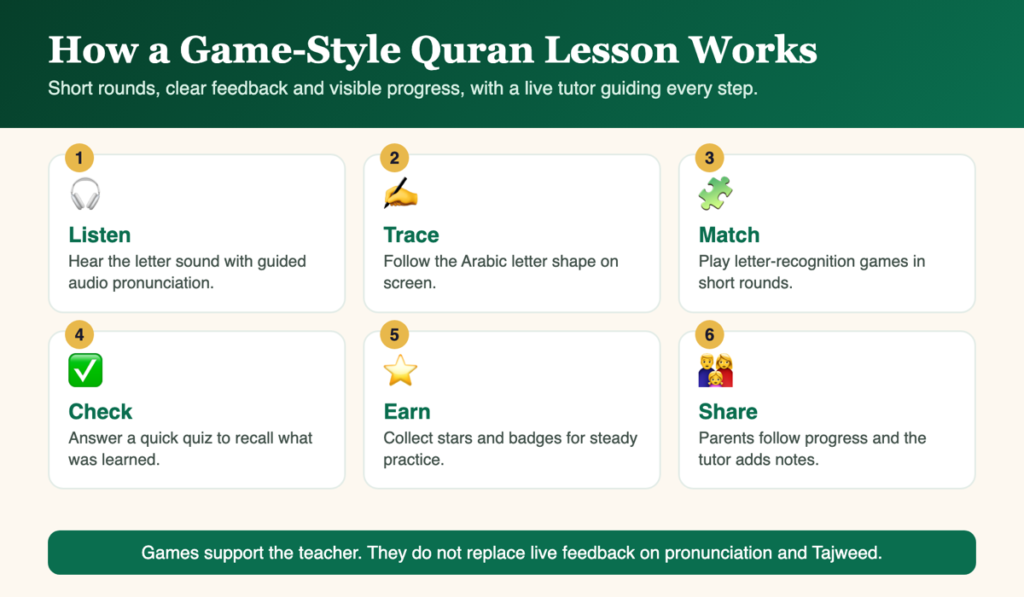
A game-style lesson works in short rounds, with a live tutor guiding every step.
Plan Lessons Around Your Time Zone
Because one-to-one lessons are scheduled individually, a weekly slot can be arranged around your child’s school term, evenings and weekends rather than a fixed class timetable. The table below shows typical after-school windows as a starting point.
| Country | Time zone | Example window | Planning tip |
|---|---|---|---|
| United Kingdom | GMT / BST | 4:30 to 7:00 pm | Clocks change in spring and autumn, so confirm the slot after each change. |
| United States | Eastern to Pacific | 4:00 to 7:30 pm | Give your own state’s time zone when booking, as the tutor may be elsewhere. |
| Canada | Newfoundland to Pacific | 4:00 to 7:30 pm | Weekend slots can suit younger children in the dark winter months. |
| Saudi Arabia | AST (UTC+3) | 4:30 to 8:00 pm | Check your school’s weekend days before choosing a weekend slot. |
| UAE | GST (UTC+4) | 4:30 to 8:00 pm | Ramadan changes the daily rhythm, so agree a new slot for the month. |
| Denmark | CET / CEST | 4:00 to 7:00 pm | A lesson at home avoids winter travel, which suits families far from a mosque. |
| Finland | EET / EEST | 4:00 to 7:30 pm | Dark winter afternoons make a lesson at home easier than an evening journey. |
| Nigeria | WAT (UTC+1) | 4:30 to 7:30 pm | Choose the time of day when your connection and power are most reliable. |
These are examples only. The tutor and the family confirm the exact weekly slot.

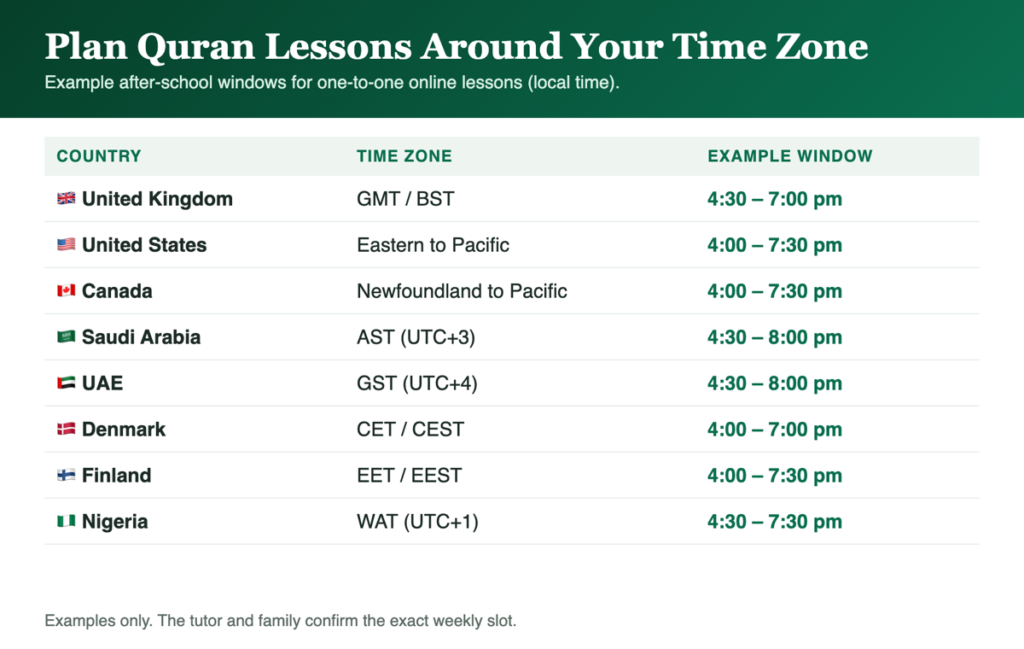
Example lesson windows by country. The exact slot is agreed with the tutor.
How NoorPath Academy Approaches Online Quran Learning
NoorPath Academy is an online-only Quran academy. It has no campuses or branches. Every lesson is a live one-to-one video lesson with a Quran teacher, and learners join from home, including families in the UK, the USA, Canada, Saudi Arabia, the UAE, Denmark, Finland and Nigeria. In practice, that means:
- Live one-to-one lessons for learners from age 4 through adults, from Noorani Qaida (Arabic letters) to Quran reading, Tajweed and Hifz.
- Tutors with credentials. Every NoorPath tutor holds an Ijazah or a Quran teaching certificate, and parents can ask to see it.
- Female tutors are available for sisters, daughters and young children.
- Matching by time zone, age, level and preference. If a child is not comfortable with the tutor, NoorPath changes the tutor.
- An interactive Noorani Qaida platform with guided audio pronunciation, letter games, Arabic tracing practice, stars and badges, and visible progress tracking.
- A Parent Portal where enrolled families follow homework, daily progress, quizzes, attendance and teacher reports.
- A free trial first. New students get 3 free 30-minute live lessons with no credit card required. Paid plans start at $29 a month for one weekly lesson, with family discounts for siblings.
If you would like to meet a matched tutor before paying anything, you can book a free trial class with NoorPath Academy and compare the experience with any other option on your shortlist.
A Simple First-Month Plan for Parents
- Note the starting point. Is your child learning letters, joining short words or reading fluently? A tutor will check this, but your own notes help.
- Use the trial to judge the fit. Watch the tutor’s pace and tone, listen to the audio quality and ask how progress is shared with parents.
- Fix a regular slot. A recurring day and time works better than ad hoc lessons, because children settle into a routine.
- Add ten minutes of practice between lessons. Letter games or listen-and-repeat are enough. Stop while your child still feels successful.
- Review after four weeks. Ask what has improved, what comes next and whether the lesson length and frequency suit your child.
Common Mistakes to Avoid
- Choosing by price alone. A lower fee is no bargain if lessons are rarely held or the teacher is not qualified.
- Skipping the trial. Comfort with a tutor is hard to judge from a website.
- Expecting games to replace a teacher. Games help recognition, not Tajweed correction.
- Booking lessons that are too long or too late for a young child. Short, regular lessons usually work better than long, tiring ones.
- Ignoring the terms. Read the cancellation notice and refund policy before you pay.
Conclusion
Living abroad does not mean choosing between school, work and Quran learning. The strongest online Quran learning combines three things: a qualified live teacher, short interactive practice that children enjoy and a routine that fits your family’s time zone. Ask the questions in the checklist, use a trial to test the fit and keep practice short and regular. Whether you live in London, Toronto, Riyadh, Dubai, Copenhagen, Helsinki or Lagos, a steady routine matters more than a perfect start.
Frequently Asked Questions
What age can a child start online Quran lessons?
Many academies begin around age 4 or 5. NoorPath arranges live one-to-one classes from age 4, depending on tutor availability, and its interactive Noorani Qaida reference is designed for ages 3 to 12.
Is online Quran learning as effective as a mosque class?
It can be, if the lessons are live, the teacher is qualified and practice is regular. One-to-one teaching gives more individual attention than a large class, and some families combine online lessons with learning in their local community.
How do I keep my child focused?
Keep lessons short, use a fixed time, add brief game-style practice between lessons and praise effort, not only correct answers. If a child refuses, first check the timing, the lesson length and the fit with the teacher.
Can my daughter learn with a female teacher?
Yes. NoorPath has female Quran tutors available for sisters, daughters and young children, and families can state a male or female preference when matching.
How much do online Quran classes cost?
Prices vary between academies. At NoorPath, plans start at $29 a month for one weekly lesson, family discounts apply for siblings and the first three 30-minute trial lessons are free. A full refund is available if requested within seven days of the first paid class, and paid plans can be cancelled with seven days’ notice before the next billing date.
Can families in Nigeria, Saudi Arabia or Denmark join lessons?
Yes. Lessons are live and one-to-one, so the tutor is matched to your time zone. You need a stable internet connection and a device with a camera and a microphone.