


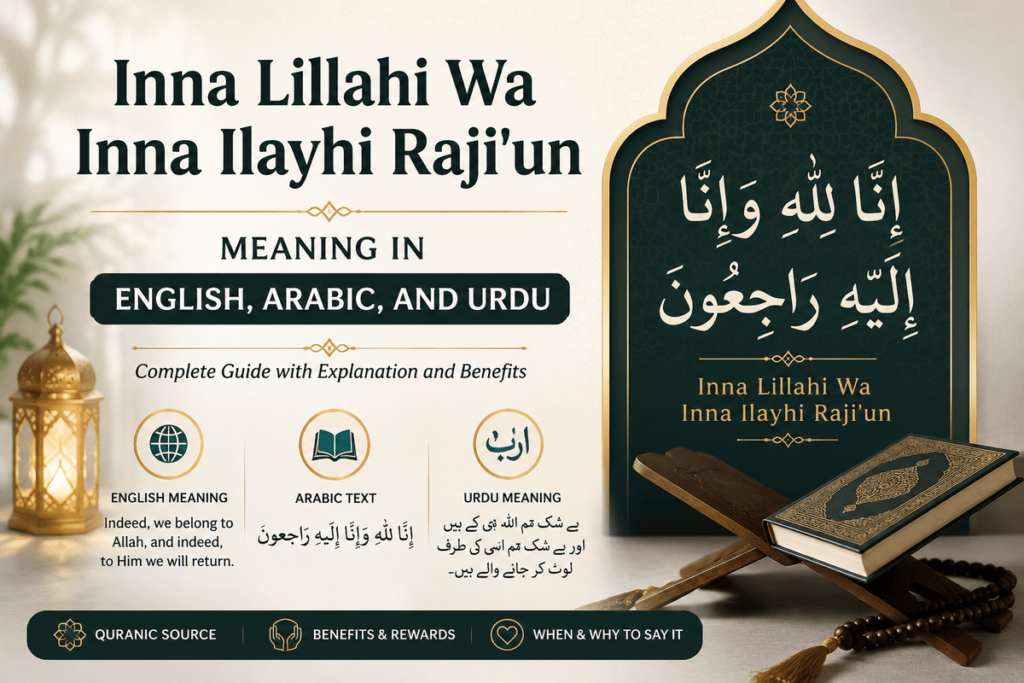
Inna Lillahi Wa Inna Ilayhi Raji’un” is one of the most well-known Islamic phrases recited by Muslims around the world. Whether someone experiences the loss of a loved one, faces a personal hardship, or hears sad news, this powerful Quranic phrase serves as a reminder of faith, patience, and trust in Allah.
Many people search for the innalillahiwainnailaihirojiun meaning, its Arabic text, and its Urdu translation because they want to understand the deeper message behind these words. While the phrase is commonly associated with death and condolences, its meaning extends far beyond that. It teaches Muslims how to respond to every trial and difficulty with patience and submission to Allah.
In this article, you will learn the complete meaning of Inna Lillahi Wa Inna Ilayhi Raji’un in English, Arabic, and Urdu, its Quranic origin, significance in Islam, benefits of reciting it, and when it should be used.
Inna Lillahi Wa Inna Ilayhi Raji’un in Arabic
If you are searching for innalillahiwainnailaihirojiun in arabic, the phrase is written as:
إِنَّا لِلَّٰهِ وَإِنَّا إِلَيْهِ رَاجِعُونَ
Transliteration
Inna Lillahi Wa Inna Ilayhi Raji’un
This phrase comes directly from the Quran and is one of the most frequently recited expressions among Muslims.
Inna Lillahi Wa Inna Ilayhi Raji’un Meaning in English
The English translation of:
إِنَّا لِلَّٰهِ وَإِنَّا إِلَيْهِ رَاجِعُونَ
is:
“Indeed, we belong to Allah, and indeed, to Him we will return.”
This simple translation carries profound meaning. It reminds us that everything we have—including our lives, families, wealth, health, and possessions—belongs to Allah. Since everything belongs to Him, He has the right to give and take as He wills.
The second part of the phrase reminds us that every human being will eventually return to Allah after death and be accountable for their actions.
Inna Lillahi Wa Inna Ilayhi Raji’un Meaning in Urdu
Many Urdu-speaking Muslims search for the innalillahiwainnailaihirojiun meaning in urdu to understand its message more clearly.
Urdu Translation
“بے شک ہم اللہ ہی کے ہیں اور بے شک ہم اسی کی طرف لوٹ کر جانے والے ہیں۔”
This translation emphasizes that our existence begins with Allah and ultimately returns to Him. It encourages believers to remain patient during hardships and trust Allah’s wisdom.
Quranic Source of Inna Lillahi Wa Inna Ilayhi Raji’un
This phrase appears in the Quran in Surah Al-Baqarah:
“Who, when disaster strikes them, say, ‘Indeed we belong to Allah, and indeed to Him we will return.'”
(Quran 2:156)
The verse is part of a passage that discusses patience during trials and hardships. Allah informs believers that they will be tested with fear, hunger, loss of wealth, loss of lives, and loss of fruits. Those who respond with patience and faith receive Allah’s mercy and guidance.
This shows that the phrase is not only for death but for all forms of difficulties and challenges.
Why Do Muslims Say Inna Lillahi Wa Inna Ilayhi Raji’un?
Muslims recite this phrase because it is a declaration of faith and acceptance of Allah’s decree.
When a believer says these words, they acknowledge:
- Allah is the Owner of everything.
- Every blessing comes from Allah.
- Every loss occurs by Allah’s permission.
- Life in this world is temporary.
- The Hereafter is eternal.
- We will all return to Allah one day.
These reminders help believers remain patient and avoid despair during difficult moments.
When Should You Say Inna Lillahi Wa Inna Ilayhi Raji’un?
Many people think this phrase should only be recited when someone dies. However, Islamic teachings show that it can be said whenever a person experiences a calamity or hardship.
Situations Where It Can Be Recited
1. Upon Hearing News of a Death
This is the most common situation. Muslims recite it when they learn about the passing of a family member, friend, or any Muslim.
2. During Personal Loss
If someone loses their job, property, wealth, or another important blessing, they may recite this phrase.
3. During Illness
Serious illness can be a difficult test. Reciting this phrase helps believers remember Allah and seek patience.
4. During Emotional Hardships
People experiencing grief, stress, heartbreak, or disappointment can also benefit from reciting these words.
5. During Any Calamity
Natural disasters, accidents, financial struggles, and other trials are all situations where Muslims may say this phrase.
The Spiritual Meaning Behind the Phrase
The beauty of Inna Lillahi Wa Inna Ilayhi Raji’un lies in its spiritual depth.
It Teaches Humility
Humans often become attached to worldly things. This phrase reminds us that nothing truly belongs to us.
It Encourages Patience
Patience (Sabr) is one of the most valued qualities in Islam. Reciting these words helps calm the heart during difficult situations.
It Strengthens Faith
Believers understand that every event occurs according to Allah’s wisdom and plan.
It Provides Comfort
The phrase reassures Muslims that this life is temporary and that Allah’s reward is greater than any worldly loss.
Benefits of Reciting Inna Lillahi Wa Inna Ilayhi Raji’un
There are numerous spiritual benefits associated with reciting this Quranic phrase.
1. Earns Allah’s Mercy
The Quran mentions that those who respond to calamities with patience receive Allah’s blessings and mercy.
2. Brings Inner Peace
Reciting the phrase reminds believers that Allah is in control of every situation.
3. Reduces Anxiety and Stress
Faith in Allah’s plan helps reduce excessive worry about life’s challenges.
4. Increases Trust in Allah
The phrase reinforces reliance upon Allah during difficult times.
5. Helps Develop Gratitude
Even during loss, believers remember the countless blessings Allah has already given them.
Tafsir and Deeper Explanation of Inna Lillahi Wa Inna Ilayhi Raji’un
The phrase “Inna Lillahi Wa Inna Ilayhi Raji’un” is much more than a statement recited after hearing sad news. It is a complete worldview that teaches Muslims how to understand life, loss, and their relationship with Allah.
Allah mentions this phrase in Surah Al-Baqarah after informing believers that they will be tested with fear, hunger, loss of wealth, loss of lives, and loss of provisions. These tests are a natural part of life and are not necessarily signs of Allah’s displeasure. Instead, they are opportunities for believers to demonstrate patience and faith.
“Inna Lillahi” – Indeed, We Belong to Allah
The first part of the phrase, “Inna Lillahi”, means “Indeed, we belong to Allah.”
This statement reminds us that:
- Our lives belong to Allah.
- Our families belong to Allah.
- Our wealth belongs to Allah.
- Our health belongs to Allah.
- Everything we possess is a trust from Allah.
People often become deeply attached to worldly things and begin to view them as permanent possessions. However, Islam teaches that everything is temporary and entrusted to us by Allah. When a believer says “Inna Lillahi,” they acknowledge Allah’s ownership over all creation.
This understanding helps reduce excessive attachment to worldly matters and encourages gratitude for every blessing.
“Wa Inna Ilayhi Raji’un” – And Indeed, To Him We Will Return
The second part, “Wa Inna Ilayhi Raji’un,” means “And indeed, to Him we will return.”
This serves as a reminder that:
- Every human being will die.
- Life in this world is temporary.
- The Hereafter is the true and eternal life.
- Every person will stand before Allah for accountability.
When believers remember their return to Allah, they gain a broader perspective on life’s difficulties. Temporary hardships become easier to endure when viewed in light of the eternal reward awaiting the patient and faithful.
The Connection Between Patience and This Verse
One of the most important lessons from this verse is Sabr (Patience).
Islam does not teach believers to ignore grief or suppress emotions. Even the Prophets experienced sadness and loss. However, Muslims are encouraged to respond to difficulties with patience, trust, and hope in Allah’s mercy.
Reciting Inna Lillahi Wa Inna Ilayhi Raji’un is an act of worship because it reflects acceptance of Allah’s decree while seeking His reward.
A Reminder During Every Trial
Although many people associate this phrase only with death, scholars explain that it can be recited during any hardship.
For example:
- Losing a loved one
- Financial difficulties
- Serious illness
- Job loss
- Emotional pain
- Natural disasters
Every challenge can remind a believer of the reality that everything belongs to Allah and that ultimate success lies in returning to Him with faith.
Allah’s Promise for Those Who Recite It
Immediately after mentioning this phrase in Surah Al-Baqarah, Allah praises those who say it during times of hardship:
“Those are the ones upon whom are blessings from their Lord and mercy. And it is those who are rightly guided.”
(Quran 2:157)
This verse highlights three special rewards:
- Blessings from Allah
- Allah’s Mercy
- Guidance to the Straight Path
These rewards demonstrate why this phrase is considered one of the most powerful responses to adversity in Islam.
The Ultimate Lesson
The deeper message of Inna Lillahi Wa Inna Ilayhi Raji’un is that every blessing and every trial should bring a believer closer to Allah. It teaches humility, patience, gratitude, and reliance upon the Creator.
Rather than focusing only on what has been lost, the phrase encourages Muslims to remember the One who remains constant—Allah. Through this perspective, believers find comfort, strength, and hope even in life’s most difficult moments.
Morning Dua to Start Your Day With Peace, Protection, and Blessings