


The Adhan (Azan) is one of the most beautiful and recognizable aspects of Islam. It is the call to prayer that reminds Muslims of their duty to worship Allah and gather for Salah. However, many Muslims are unaware that there is a special dua to recite after the Azan, a supplication that carries immense rewards and blessings.
The Prophet Muhammad (ﷺ) encouraged believers to repeat the words of the Mu’adhin (the person calling the Azan) and then recite a specific dua after the call to prayer. This simple act takes less than a minute but can bring tremendous spiritual benefits.
In this guide, you will find the full dua after Azan in Arabic, transliteration, and English meaning, along with its importance, benefits, and frequently asked questions.
What Is the Dua After Azan?
The dua after Azan is a supplication taught by Prophet Muhammad (ﷺ). Muslims recite it immediately after the Adhan has ended. This dua asks Allah to grant Prophet Muhammad (ﷺ) the honored position of Al-Wasilah and Al-Fadilah and to raise him to the praised station promised by Allah.
According to authentic Hadith, whoever recites this dua sincerely after hearing the Azan will receive the intercession (Shafa’ah) of the Prophet (ﷺ) on the Day of Judgment.
Dua After Azan in Arabic
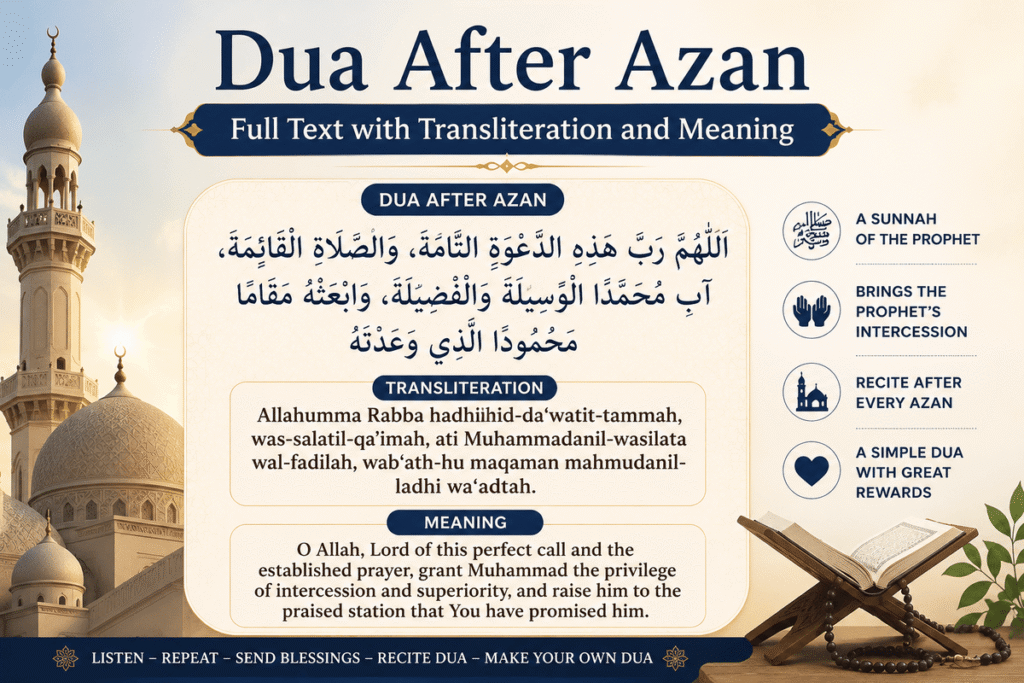
اللَّهُمَّ رَبَّ هَذِهِ الدَّعْوَةِ التَّامَّةِ، وَالصَّلَاةِ الْقَائِمَةِ، آتِ مُحَمَّدًا الْوَسِيلَةَ وَالْفَضِيلَةَ، وَابْعَثْهُ مَقَامًا مَحْمُودًا الَّذِي وَعَدْتَهُ
Transliteration
Allahumma Rabba hadhihid-da‘watit-tammah, was-salatil-qa’imah, ati Muhammadanil-wasilata wal-fadilah, wab‘ath-hu maqaman mahmudanil-ladhi wa‘adtah.
English Meaning
“O Allah, Lord of this perfect call and the established prayer, grant Muhammad the privilege of intercession and superiority, and raise him to the praised station that You have promised him.”
Authentic Hadith About the Dua After Azan
The Prophet Muhammad (ﷺ) said:
“Whoever says when he hears the call to prayer: ‘O Allah, Lord of this perfect call and the established prayer, grant Muhammad the Wasilah and excellence, and raise him to the praised station You have promised him,’ my intercession for him becomes guaranteed on the Day of Resurrection.”
This hadith highlights the immense value of this short yet powerful supplication.
When Should You Recite the Dua After Azan?
The dua should be recited immediately after the Azan has finished.
The recommended sequence is:
- Listen attentively to the Azan.
- Repeat the words of the Mu’adhin.
- Send blessings upon Prophet Muhammad (ﷺ).
- Recite the dua after Azan.
- Make personal supplications, as this is a blessed time when duas are accepted.
Why Is the Dua After Azan Important?
Many Muslims focus on the prayer itself but overlook the moments surrounding it. The time after Azan is a special opportunity for remembrance of Allah and making dua.
The dua after Azan is important because:
- It follows the Sunnah of Prophet Muhammad (ﷺ).
- It strengthens your connection with Salah.
- It brings the intercession of the Prophet (ﷺ).
- It serves as a reminder of the importance of worship.
- It helps prepare the heart for prayer.
Even though it takes less than a minute, its rewards are significant.
Benefits of Reciting Dua After Azan
1. Earn the Prophet’s Intercession
One of the greatest benefits mentioned in authentic Hadith is receiving the intercession of Prophet Muhammad (ﷺ) on the Day of Judgment.
Every Muslim hopes for the Prophet’s intercession, and this simple supplication is one way to attain it.
2. Follow an Authentic Sunnah
Reciting the dua after Azan is a practice directly taught by the Prophet (ﷺ). Following the Sunnah brings blessings and strengthens faith.
3. Increase Love for the Prophet (ﷺ)
The dua contains a request for Allah to elevate the status of Prophet Muhammad (ﷺ). Repeating this supplication regularly increases love and respect for him.
4. Gain Spiritual Rewards
Remembering Allah before Salah helps purify the heart and focus the mind on worship.
5. Prepare Yourself for Prayer
The moments before Salah can be distracting. This dua helps transition from worldly matters to spiritual reflection.
What Is Al-Wasilah Mentioned in the Dua?
The word “Al-Wasilah” refers to a special rank in Paradise.
The Prophet (ﷺ) explained that Al-Wasilah is the highest station in Paradise and that he hopes to be the one granted this position.
By reciting the dua after Azan, Muslims ask Allah to grant this honored rank to His Messenger.
Can You Make Personal Dua After Azan?
Yes.
The time between Azan and Iqamah is considered a blessed period for supplication.
The Prophet Muhammad (ﷺ) taught that supplications made between the call to prayer and the commencement of prayer are not rejected.
After reciting the prescribed dua, Muslims may ask Allah for forgiveness, guidance, provision, health, success, and any lawful need.
Common Mistakes Muslims Make
Not Listening to the Azan
Some people continue conversations or remain distracted while the Azan is being called.
The Sunnah encourages Muslims to listen carefully and repeat the words of the Mu’adhin.
Forgetting the Dua
Many Muslims know the importance of Salah but are unaware of the special dua after Azan.
Learning and memorizing it can help revive this beautiful Sunnah.
Rushing Into Other Activities
After hearing the Azan, some immediately return to work, social media, or other tasks without taking advantage of this blessed moment.
Incorrect Pronunciation
If Arabic is not your first language, use transliteration while learning. With regular practice, pronunciation will improve.
How to Memorize the Dua After Azan
Memorizing this dua is easier than many people think.
Try these methods:
Read It Daily
Recite it after every Azan. Repetition naturally strengthens memory.
Use Flashcards
Write the Arabic text on one side and the transliteration on the other.
Listen to Audio Recordings
Hearing proper pronunciation repeatedly helps with memorization.
Practice With Family
Parents can encourage children to recite the dua together after each Azan.
Learn Small Sections
Break the dua into shorter phrases and memorize one part at a time.
Teaching Children the Dua After Azan
Children learn best through consistency and example.
Parents can:
- Recite the dua aloud after every Azan.
- Explain its meaning in simple language.
- Use visual charts and posters.
- Reward memorization efforts.
- Encourage daily practice.
Teaching children this Sunnah at a young age can help establish lifelong habits of worship.
Frequently Asked Questions
Is the Dua After Azan Obligatory?
No. It is not obligatory, but it is a highly recommended Sunnah practice.
Can Women Recite the Dua After Azan?
Yes. The dua after Azan is recommended for both men and women.
Should I Recite It After Every Azan?
Yes. It is recommended after every call to prayer.
Can I Read It From My Phone?
Yes. Until you memorize it, you may read it from your phone or a printed card.
What If I Forgot to Recite It?
You are not sinful. Simply try to remember it the next time you hear the Azan.
Is There a Different Dua for Fajr Azan?
No. The same dua is generally recited after all daily Adhans.
Final Thoughts
The dua after Azan is one of the easiest Sunnahs to practice yet one of the most rewarding. It takes only a few moments to recite but carries tremendous spiritual benefits, including the promise of the Prophet’s intercession on the Day of Judgment.
By listening attentively to the Azan, repeating its words, sending blessings upon Prophet Muhammad (ﷺ), and reciting this powerful supplication, Muslims can earn rewards and strengthen their connection with Allah.
Make it a habit to recite the dua after every Azan. Over time, this simple practice can become a meaningful part of your daily worship and a source of immense blessings in this life and the Hereafter.